
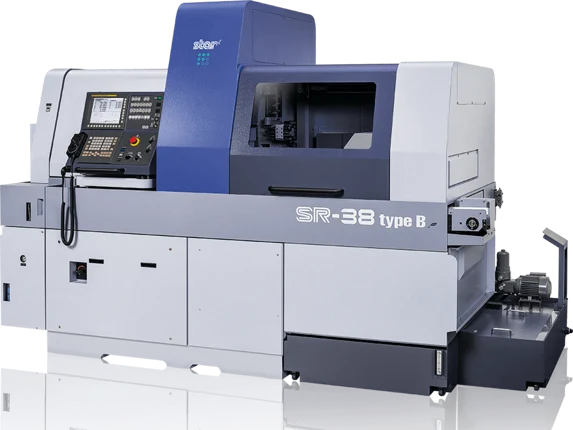
Buying the machine does not mean using its full capability
When evaluating the capacity of a Swiss-type CNC, it is necessary to look at which of the operations required in the part can be taken into the same production flow. rotary cutting tools and counter spindles offer additional options under the appropriate hardware and parts conditions. Failure to use them does not always mean incomplete capacity utilization; the decision must be based on the need of the part.
However, we don't have to process every piece in a multi-axis. A simple program can be the right choice if the technical drawing only requires two-axis turning. The problem is to transfer the work to the second or third CNC machine without evaluating the appropriate hardware of the CNC machine, although additional operation is needed on the part.
Understanding the real advantage of Swiss-type turning
In the sliding-head processing layout, the rod material moves axially. The guide bushing uses close support to the machining area, helping to stable processing of particularly long and thin geometries in suitable parts. In addition, numerous models offer complementary live tooling and back-face processing possibilities for turning.
These capabilities should not be assumed to be identical on every model. Axis layout, tool stations, subspindle, guide-bushing-free operation and control functions vary. Plan the work around the actual installed machine configuration rather than a generic catalogue description.
What does a two-axis approach miss?
Consider a pin with a radial hole, wrench flats and a hole in the rear face. If the part is turned and parted off, then moved to other machines for drilling and milling, it requires reclamping, orientation, work in progress and operator handling. Suitable Swiss-type equipment may bring these features into a single production workflow.
The goal here is not to force all operations into one CNC machine. Separate operation may be more accurate if the cutting tool access, rigidity, material, chips control or operating power is insufficient. The decision should be made by evaluating the total time and quality requirements per piece together.
Multi-axis does not mean simultaneous five-axis machining
The number of axises that can be contaminate with the number of axis is different concepts. Multi-axis use in Swiss-type CNCs also includes the planning of different cutting tool groups, main and opposite spindles, and appropriate channel structure together. Not every movement needs to be done at the same time.
Some models can carry out suitable back-working operations while front-side machining continues, or distribute tasks between independent tool groups. Manufacturer descriptions of the STAR SR-38, SW-20 and ST-20 show different examples of overlapping operations; these capabilities cannot be assumed for every model. Programs must use a postprocessor and kinematic model appropriate to the machine.
Why does capacity remain unused?
Splitting operations according to established habits, assuming that second-operation fixtures are unavoidable, or treating multi-channel programming as a specialist-only task can limit capacity utilisation. Missing live-tool holders, inadequate training and an unverified postprocessor may also create technical barriers. These issues require a review of the complete production system, not just the machine.
The first step is to select a part family and write down the current chain of operations. Then the process that can be done in the CNC machine, the necessary cutting tool investment, preparation time and possible quality effect are evaluated. While channel waitings are reduced, collision, transfer and workingholding controls must be maintained; mass production should not be switched before the first part measurement is completed.
Measure success not with a full screen, but with the completed part
The fact that all axes move on the program screen does not prove that investment is being used efficiently. Less workholding, less work in progress, stable cycle and lower accepted cost per part are real indicators. Simple use in simple jobs may be correct; and unused capacity should be questioned in multi-operating jobs.
Using the Swiss-type CNC correctly is not about running it continuously complex. It is about combining the hardware, operations and programming competence that meets the part's needs in the same production plan.
| Title | Evaluation |
|---|---|
| Only the part that needs turning | The simple program can be economic and accurate. |
| part containing radial hole and plane | The appropriate live tool and axis configuration are evaluated. |
| The part where the back-face operation is required | The opposite spindle and rear processing capacity are controlled. |
| Long channel waits | Safe operation overlap and channel load balance are examined. |
Technical resources
Manufacturer resources are meant to verify CNC machine properties. Efficiency assessments depend on the part and production plan; no specific rate of gain is committed.
Operations are verified through technical drawing, material, workholding, cutting tool and CNC machine configuration.
← Back to all articlesNext step for your piece
Methods Compare on part geometry and quantity of production. For production continuity chips controlFor the admission process, the measurement report scope and evaluate.