
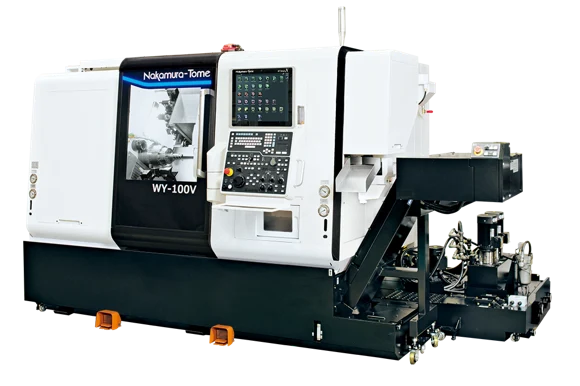
Turning and milling in one production workflow
Mill-turn machining combines turning and milling on one machine. Alongside turning diameters, grooving and threading, suitably equipped models can machine features such as holes, flats and pockets. The benefit is not simply the number of operations available. It is the opportunity to reduce transfers between machines, reclamping and repeated datum setting.
Not every mill-turn has the same capacity. The Y axis, counter spindle, turret number, live tool strength and control system determine which operations can be combined. The mill-turn expression does not mean that all parts are finished in a single working process, either by simultaneous five axis processing alone or by a single working process.
Contribution to quality: shortening the reference chain
Reconnecting a part in different CNC machines creates a new need for positioning and control at each stage. The operation plan becomes critical, especially in holes, surfaces and diameters whose position is important relative to each other. Processing more features in a common workholding layout can help reduce the variables resulting from reattaching.
However, manufacturing on a single CNC machine does not mean automatically producing the right parts. cutting tool wear, working force, temperature effects and cutting conditions should be checked again. Quality gain; the appropriate order of operation, determined process, and technical drawing according to the prepared measurement plan.
The deadline is not just the cycle time
In the production plan, the amount of time a part spends on a CNC machine is important as well as the amount of time it expects between operations. Separate lathe and milling operations may require transport, work in progress, fixture preparation, and queue waiting on the second CNC machine. Combining operations offers an opportunity to simplify this flow.
Mill-turn CNC machine cutting time may not always be shorter. In some operations, an independent machining center may be stronger or more suitable. Therefore, the comparison should be done not only according to the time in the program but also through the part that meets the criteria of preparation, transport, intermediate control, reworking and acceptance.
Establishing balance in multichannel production
In suitable CNC machines with double spindles and multiple turrets, the workload can be distributed between front and rear face operations. The gain is that operations are securely overlapped and one channel does not expect the other unnecessarily. Running more cutting tools at the same time does not indicate that an efficient process has been established alone.
For example, if the radial hole of a lathed body, the milled plane, and the rear-face process are completed in separate CNC machines, the integration of these operations in the same system can be evaluated. However, the tool access, workholding during transfer, chips evacuation, and collision risk should be specifically confirmed to the model.
Accurately measure the return on investment
The correct question for the mill-turn investment is not limited to "How many axis does it have?" The question "Which part family do we take away from the carrying, working and waiting step?" can be more useful. In complex and multi-operating parts, the advantage can grow; in parts that only require simple turning, a simpler CNC machine can be economical.
The total preparation time, the cost per accepted part, the correct production rate at the first time, the work in progress and delivery time should be monitored together in the evaluation. The mill-turn shows its contribution to the industry, not by the number of axes; it shows how controlled and lean it makes the production flow.
| Title | Evaluation |
|---|---|
| Reworking | Workholding and reference steps may be reduced in operations that can be combined. |
| Intermediate stock | When the need for CNC inter-machine transfer is reduced, the semi-finished flow can be simplified. |
| Quality | Common reference relationships can be maintained; measurement and process control are again required. |
| Cost | Instead of CNC machine minutes, the total cost of the accepted part is assessed. |
Technical resources
Manufacturer resources are meant to verify CNC machine properties. Efficiency assessments depend on the part and production plan; no specific rate of gain is committed.
Operations are verified through technical drawing, material, workholding, cutting tool and CNC machine configuration.
← Back to all articlesNext step for your piece
Methods Compare on part geometry and quantity of production. For production continuity chips controlFor the admission process, the measurement report scope and evaluate.